The Kilpatrick-Dahlgren Raid to Richmond
by Susan Deily-Swearingen
The failed Kilpatrick Dahlgren Raid, February 28 – March 3, 1864, led by Union Cavalry officers Major General Hugh Judson Kilpatrick and Colonel Ulric Dahlgren, was an attempt to free Union prisoners from Belle Isle and Libby Prison in Richmond. Papers found on the body of Ulric Dahlgren, who did not survive the assault, made this a controversial episode from the late Civil War. While some scholars question the authenticity of the papers, they appear to show that raid architects had additional goals of laying waste to Richmond and assassinating Confederate President Jefferson Davis. When Confederate forces discovered these papers, Union officials protested having any knowledge of those secondary objectives, much less ordering them. On the evening of February 28, Kilpatrick's cavalry division of 4,000 men left Stevensburg, Virginia, and headed for Richmond. Dahlgren and around 500 men, were to rendezvous with Kilpatrick later. However, both groups encountered more significant difficulties than they had anticipated. Arriving at Richmond on March 1, Kilpatrick’s force was confronted by Confederate troops tasked with defense of the city who drove the Federals off. Dahlgren attempted to enter Richmond from the south and was also driven off by Confederate cavalry. Dahlgren then attempted to enter the city again, from the north, on March 2. Separated from his main body Dahlgren was ambushed and killed, with ninety of his men taken prisoner. When the controversy over the captured papers was reported in Confederate newspapers, Lincoln Meade and Kilpatrick all denied that any such orders had been given, Meade went so far as to write directly to Lee. Lee’s response appeared to indicate he did not believe the papers were authentic and further stated that the captured Federals should not suffer just because they had followed unjust orders. To this day the controversy over the authenticity of the papers found on Colonel Dahlgren remains unresolved.
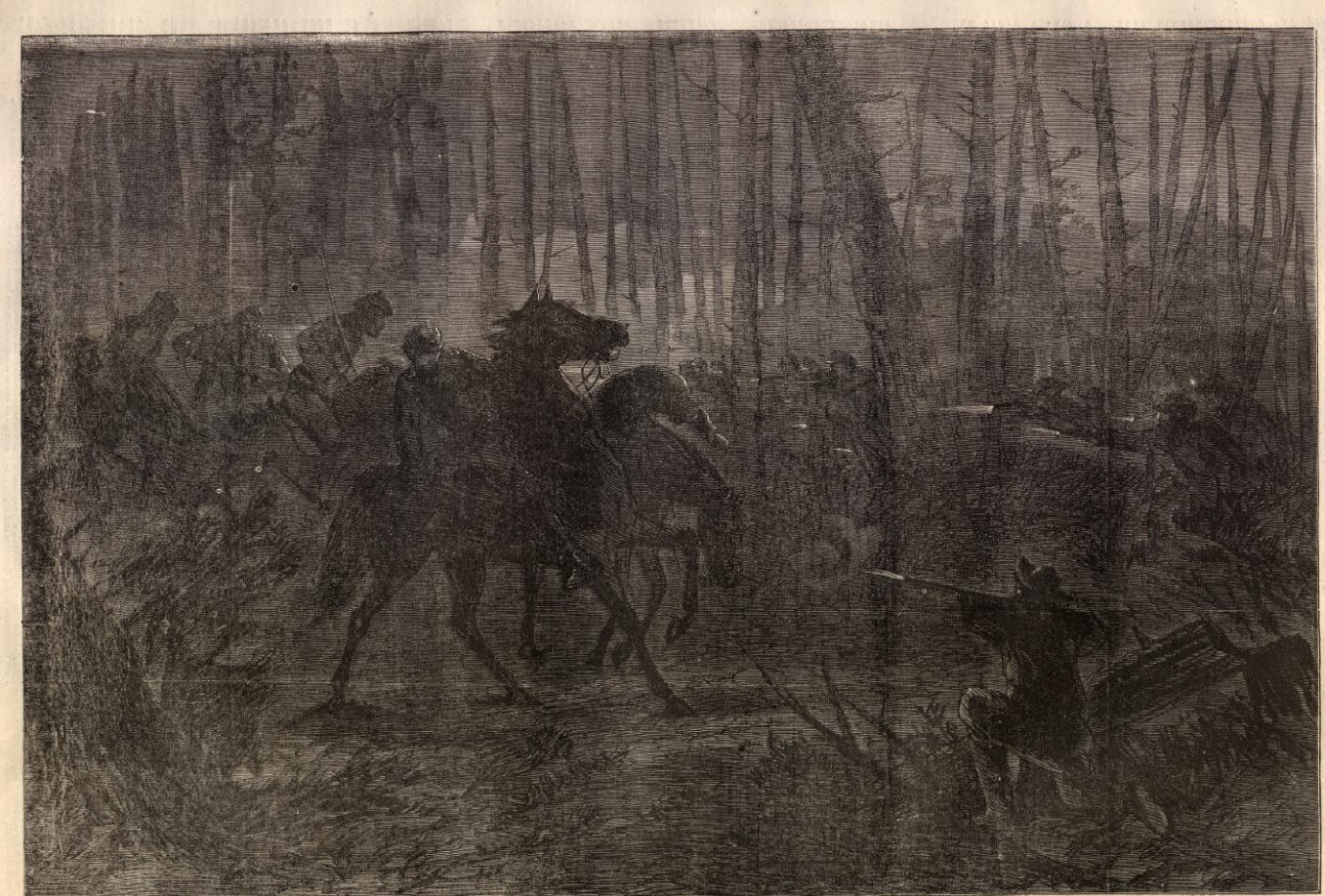
Ambush and Death of Colonel Dahlgren
Image from Harpers Weekly March 26, 1864, page 193
The events of the Kilpatrick Dahlgren Raid, sometimes called the Dahlgren Affair, began on February 28, 1864, and lasted until March 3, just prior to the beginning of Ulysses S. Grant’s Overland Campaign in Virginia. The failed raid led by Union Cavalry officers Major General Hugh Judson Kilpatrick and Colonel Ulric Dahlgren was an attempt to free Union prisoners from Belle Isle and Libby Prison in Richmond. Papers found on the body of Ulric Dahlgren, who did not survive the assault, made this a controversial episode from the late Civil War. While some scholars question the authenticity of the papers, they appear to show that raid architects had additional goals of laying waste to Richmond and assassinating Confederate President Jefferson Davis. When Confederate forces discovered these papers, Union officials protested having any knowledge of those secondary objectives, much less ordering them.
Some contemporary historians have argued that the plans found on Dahlgren’s body were forgeries created by Confederates who used them as propaganda to showcase the depravity of the Union forces. However, given the tremendous toll the war had taken on both individuals and the nation by the time of the raid, it is not wholly unreasonable to suggest that some in the Union may have favored a turn to a more scorched earth policy seeking a faster conclusion of the conflict and a quicker end to the slaughter. For example, in July of the previous year, the Battle of Gettysburg caused over 50,000casualties over only three days of fighting.[1] The carnage in Pennsylvania was followed by the disastrous Battle of Chickamauga in September of 1863. Responsible for nearly 35,000 casualties, the battle was a pyrrhic victory for the Confederates, who lost twenty percent of their force in the effort.[2] This was followed by the Battle of Chattanooga in November, which resulted in 14,000 casualties and was a Union victory.[3]
Battlefield casualties like these, in combination with new Confederate conscription requirements and increasingly desperate home front challenges, resulted in an all-time low in Confederate morale, with significant numbers of soldiers deserting the fight. Perhaps seeing this dissatisfaction as a potential opportunity, Union forces focused their attention on Virginia and the symbolic and tactical advantages that could be gained by threatening the Confederate capital in Richmond and undermining Confederate confidence even further.
While not an everyday occurrence, raids were still a regular feature of Civil War action on both sides. In July 1863, Confederate Cavalry Commander John Hunt Morgan led a group of men through Kentucky, Indiana, and Ohio. Morgan and his men wreaked havoc and disrupted Union supply lines while attempting to capture Louisville in a raid whose details were not unsimilar from the Kilpatrick Dahlgren Raid. While they were eventually captured by Union forces, Morgan and his men nevertheless caused significant damage in terms of property and loss of life.[4]The raid also shook the confidence and sense of security of Union forces in this area. These kinds of cavalry raids were not uncommon, but the Kilpatrick Dahlgren affair raised some intriguing additional questions (beyond the issue of destroying property) because of the prospect of assassination as a tool of war.
The Kilpatrick-Dahlgren Raid remains a subject of debate among historians, with questions lingering about its planning, execution, and ultimate objectives. While it ultimately failed to achieve its goals, the raid's legacy is a reminder of the complexities and challenges of warfare during the Civil War era. It is a cautionary tale about the risks of bold military ventures and the unpredictable nature of conflict.
The Raid
On the evening of February 28, Kilpatrick's cavalry division of 4,000 men left Stevensburg, Virginia, and headed for Richmond.[5]Dahlgren and around 500 men, were to rendezvous with Kilpatrick later. However, both groups encountered more significant difficulties than they had anticipated.
Kilpatrick's force traveled along the Virginia Central Railroad, destroying the track and rendering it useless to the Confederate war effort. Arriving at Richmond on March 1, the group was confronted by Confederate troops tasked with defense of the city. Kilpatrick, awaiting reinforcement from Dahlgren and his men, engaged with the Confederate forces, preventing his entry into Richmond. The Confederates ultimately prevailed, forcing Kilpatrick to abandon his plans and retreat. However, his withdrawal was not without peril. A detachment of Confederate Cavalry chased him and his men. Kilpatrick only eventually found security by joining forces with men under the command of Benjamin Butler, who were in the area.
At the same time, Dahlgren's forces had no better luck entering the city. He and his men attempted to cross the James River and enter Richmond from the South. Martin Robinson, an African American living in the area, unsuccessfully tried to assist Dahlgren's group in finding a safe place to cross the river. Dahlgren became suspicious of the man when no safe place could be found and had him hanged before abandoning plans to cross the James and turning to attack the city from the West instead.[6]
When this plan also failed, Dahlgren and his men had to flee Confederate cavalry, who dogged their retreat, just as other Confederate cavalry had pursued Kilpatrick.TheGeneral took his troops north, hoping to penetrate Richmond's defenses at a different location. On March 2, the day after Kilpatrick had been repulsed by Confederate forces, part of Dahlgren's detachment became separated from the main group and were ambushed. The Confederates killed Dahlgren and took 90 of his men prisoner.[7]
The failure of the Kilpatrick-Dahlgren Raid had significant consequences for both sides. It was a setback for the Union that highlighted the difficulties of conducting large-scale cavalry operations deep in enemy territory. It also raised questions about the effectiveness of Union leadership and planning. The raid was a propaganda victory for the Confederacy, showcasing their ability to defend their capital and repel enemy incursions.
Leadership
Famous raids such as those led by John Hunt Morgan and William Tecumseh Sherman are remembered as much for the men who led them as for their levels of success or failure. The Kilpatrick Dahlgren Raid remains comparatively understudied and unknown in Civil War scholarship partly because it did not achieve its primary objectives and partly because the men tasked with carrying it out are still relatively unknown and, by some of their contemporaries, were unliked.
Born on January 14, 1836, in New Jersey, Judson Kilpatrick was the son of a respected farmer and a mother of “good sense and high mental endowments.”[8]He graduated from the United States Military Academy at West Point in 1861 and joined the Union Army. Kilpatrick initially served in the artillery but quickly transferred to the cavalry, where he served for the rest of the war. Despite these relatively impressive bona fides, one officer described Kilpatrick as "the most vain, conceited , egotistical little popinjay I ever saw. He is a very ungraceful rider looking more like a monkey than a man on horseback.” One historian addresses this last insult by noting that his riding was affected by a kidney problem, which caused severe back pains as he rode.[9]
Kilpatrick was nicknamed Kill Cavalry because a significant number of cavalrymen died under his command.[10]Still, Kilpatrick also achieved a reputation for daring and bold action in the field, which helped account for his rise to the rank of Major General and his appointment to the ambassadorship of Chile after the war.
His counterpart in the raid was Ulric Dahlgren. Born in 1842 in Bucks County, PA, he was the scion of a prominent military family and the son of naval officer John Adolphus Bernard. Dahlgren. Like Kilpatrick, Dahlgren’s rise from Private to Colonel was enabled by his perceived bravery and bold actions. While Kilpatrick survived the war, Dahlgren perished during the mission in Richmond, and the papers found on his body are perhaps the most apparent reason for continuing scholarship on the raid.
Historical Controversy
According to one contemporary newspaper account, the papers found on the body of General Dahlgren authorized him and Kilpatrick to engage in what many considered acts of terrorism. The Western Democrat, a paper from Charlotte, North Carolina, reported:
Colonel Dahlgren, who was acting as Brigadier General, was killed and on his body was found instructions to release the yankee prisoners, burn the city of Richmond, kill President Davis and the Cabinet officers, and destroy property of all kinds. The yankee soldiers were provided with cotton balls soaked in spirits turpentine and torpedoes to facilitate the destruction of life and property.[11]
While the details outlined by this article were refuted by Union officials in 1864 and continue to be questioned today, the next line in the article offers some insight on why a Confederate paper would choose to publish that account regardless of the truth or fiction of the account. The journalist continues, "The whole scheme shows that the Yankee authorities are instigated by the most devilish and wicked hatred of the Confederates.”[12]In other words, Confederate propaganda aims could be served by using the example of the raid even if the authenticity of the Dahlgren papers was unknown then and is unknown now.
For their part, Abraham Lincoln, General Meade, and General Kilpatrick all denied that any such orders were given.General Meade wrote directly to General Lee to deny that papers purportedly found on General Dahlgren were authentic; “In reply I have to state the neither the United States Government, myself, nor General Kilpatrick authorized, sanctioned, or approved the burning of the city of Richmond and the killing of Mr. Davis and cabinet, nor any other act not required by military necessity and in accordance with the usages of war.”[13]
General Kilpatrick supported Meade's assertions by reporting:
I have carefully examined officers and men who accompanied Colonel Dahlgren on his late expedition. All testify that he published no address whatever to his command, nor did he give any instructions… Colonel Dahlgren received no orders from me to pillage, burn, or kill, nor were any such instructions given me by my superiors.[14]
For his part, General Lee's response to theaffair indicates that he, perhaps, did believe that the papers were authentic and represented an actual attempt by the Union Army to do serious damage to the Confederate capital and the cause it represented. Yet Lee, concluded that the men captured during Dahlgren's attempted incursion into Richmond should not suffer just because they were following unjust orders. In response to the issue of what should be done with those men, Lee wrote:
I presume that the blood boils with indignation in the veins of every officer & man as they read the account of the barbarous & inhuman plot, & under the impulse of the moment many would counsel extreme measures. But I do not think that reason & reflection would justify such a course. I think it better to do right, even if we suffer in so doing, than to incur the reproach of our consciences & posterity. Nor do I think that under present circumstances policy dictates the execution of these men. It would produce retaliation. How many & better men have we in the enemy’s hands than they have in ours?[15]
Continuing Scholarship
The authenticity of the Dahlgren Papers continues to vex some historians. This may be because there were imaginable advantages in taking such action. For example, had Kilpatrick and Dahlgren successfully assassinated Davis and done severe damage to the Confederate capital in Richmond, it likely would have crippled the Confederate war effort and destabilized the Confederate government. In 1864, after enduring three brutal years of the war, it is conceivable that such potential outcomes could have enticed someone to order such action. However, this must remain squarely in the realm of hypothesis. The potential upsides alone are not enough to validate the authenticity of documents that remain historical unknowns.
This means the legacy of the Kilpatrick Dahlgren raid is that of a failed attempt to free Union prisoners with some enticing attendant features. While the Kilpatrick-Dahlgren Raid of 1864 did not significantly impact the outcome of the Civil War in terms of achieving its intended objectives, its legacy endures as a controversial episode in Civil War history, highlighting the complexities and challenges of understanding all the aspects of the war with absolute certainty.
- [1] “Battle History | Gettysburg PA” Gettysburg Pennsylvania, https://www.gettysburgpa.gov/history/slideshows/battle-history, accessed January 21, 2025.
- [2] “Chickamauga”, American Battlefield Trust, https://www.battlefields.org/learn/civil-war/battles/chickamauga#:~:text=Catoosa%20County%20and%20Walker%20County, accessed January 21, 2025.
- [3] “Battle of Chattanooga Facts & Summary” American Battlefield Trust, https://www.battlefields.org/learn/civil-war/battles/chattanooga, accessed January 21, 2025.
- [4] For further reading, please see James A. Ramage, Rebel Raider: The Life of General John Hunt Morgan (Lexington: University Press of Kentucky, 1986). &zwnj
- [5] “Battle Detail” National Parks Service,https://www.nps.gov/civilwar/search-battles-detail.htm?battleCode=va125, accessed January 21,2025.
- [6] “Dahlgren’s Cavalry Raid” American Battlefield Trust, https://www.battlefields.org/visit/heritage-sites/dahlgrens-cavalry-raid, accessed January 21, 2025.
- [7] United States War Department, The War of the Rebellion: A Compilation of the Official Records of the Union and Confederate Armies, 70 vols. in 128 parts (Washington D.C.: Government Printing Office, 1880-1901), Series I, volume 33, p. 170-180 (hereafter cited as O.R., I, 33, 170-180); “Battle Detail” National Parks Service, https://www.nps.gov/civilwar/search-battles-detail.htm?battleCode=va125, accessed January 21, 2025.
- [8] James Moore, Kilpatrick and Our Cavalry: Comprising a Sketch of the Life of General Kilpatrick (New York: W. J. Widdleton, Publisher, 1865), 25.
- [9] Larry J. Daniel, Days of Glory: The Army of the Cumberland, 1861-1865 (Baton Rouge: Louisiana State University Press, 2004) 387.
- [10] Samuel J. Martin, “Kill-Cavalry” Sherman's Merchant of Terror: The Life of Union General Hugh Judson Kilpatrick (Madison, JJ and Vancouver, BC: Farleigh Dickinson University Press: 1996).
- [11] “The Latest News from Virginia,” The Western Democrat (Charlotte, N.C.), March 8, 1864, https://chroniclingamerica.loc.gov/lccn/sn84020712/1864-03-08/ed-1/seq-3/, accessed January 21, 2025.
- [12] Ibid.
- [13] From General George G. Meade to General Robert E Comdg. Army of Northern Virginia, April 17, 1864, O.R., I, 33, 180).
- [14] From Kilpatrick to Brigadier General S. Williams, A. A. G. Army of the Potomac, April 16, 1864, O.R., I, 33, 180.
- [15] Robert E. Lee to James A. Seddon, 1864 March 6 - Lee Family archive. Lee Family Digital Archive, https://leefamilyarchive.org/robert-e-lee-to-james-seddon-1864-march-6/, accessed January 21, 2025.
If you can read only one book:
Schulz, Duane. The Dahlgren Affair: Terror and Conspiracy in the Civil War. New York: W.W. Norton & Co., 1998.
Books:
Daniel, Larry J. Days of Glory: The Army of the Cumberland, 1861-1865. Baton Rouge: Louisiana State University Press, 2004.
Martin, Samuel J. “Kill-Cavalry” Sherman's Merchant of Terror: The Life of Union General Hugh Judson Kilpatrick. Madison, NJ and Vancouver, BC: Farleigh Dickinson University Press: 1996.
Moore, James. Kilpatrick and Our Cavalry: Comprising a Sketch of the Life of General Kilpatrick. New York: W. J. Widdleton, Publisher, 1865.
United States War Department. The War of the Rebellion: A Compilation of the Official Records of the Union and Confederate Armies, 70 vols. in 128 parts. Washington D.C.: Government Printing Office, 1880-1901), Series I, volume 33, p. 170-180.
Organizations:
No organizations listed.
Web Resources:
No web resources listed.
Other Sources:
The New York Times, March 7, 1864.
The Richmond Raid; our forces enter the fortifications a fight there with a rebel battery. The spires of the city in view. railroads, canals, telegraphs, bridges, mills and supplies destroyed. Colonel Dahlgren's expedition led astray by a guide and the guide hanged. Sublime audacity of Kilpatrick, he fights all day inside the rebel works. He camps at night just outside the city. astonishment of the fair sex at the boldness of the Yankees. highly interesting details from our special correspondent with the expedition. the expedition. details of the movement. The approach to Richmond. col. Dahlgren's expedition.